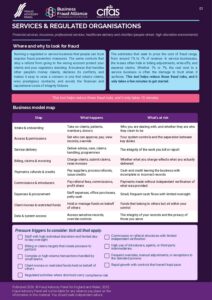
Where and why to look for fraud
Running a regulated or service business that people can trust requires fraud prevention measures. The same controls that stop a refund from going to the wrong account protect your clients and your regulatory standing. A business that handles other people’s money cleanly, declares its conflicts, and makes it easy to raise a concern is one that retains clients, wins prestigious contracts, and avoids the financial and reputational costs of integrity failures.
The estimates that seek to price the cost of fraud range, from around 1% to 7% of revenue. In service businesses, the losses often hide in billing adjustments, write-offs, and expense claims. Whether 1% or 7%, the real cost to a service business is often the damage to trust when it surfaces. This tool helps reduce those fraud risks, and it only takes a few minutes to get started.
Business model map
| Step | What happens | What’s at risk |
|---|---|---|
| Intake & onboarding | Take on clients, patients, members, donors | Who you are dealing with, and whether they are who they claim to be |
| Access & permissions | Set who can approve, pay, view records, override | Your system controls and the separation between key duties |
| Service delivery | Deliver advice, care, claims handling, programmes | The integrity of the work you bill or report |
| Billing, claims & invoicing | Charge clients, submit claims, raise invoices | Whether what you charge reflects what you actually delivered |
| Payments, refunds & credits | Pay suppliers, process refunds, issue credits | Cash and credit leaving the business with incomplete or incorrect records |
| Commissions & introducers | Pay referral fees, commissions, profit share | Payments made without independent verification of what was provided |
| Expenses & procurement | Staff expenses, office purchases, petty cash | Small, frequent cash flows with limited oversight |
| Client monies & restricted funds | Hold or manage funds on behalf of others | Funds that belong to others but sit within your control |
| Data & system access | Access sensitive records, override controls | The integrity of your records and the privacy of those you serve |
Pressure triggers to consider: tick all that apply.
| Tick | Pressure trigger |
|---|---|
Red flags and what to look for
One incident is rarely proof; look for two or three in the same area. Use the following as a checklist to identify things that require investigation.:
Onboarding & conflicts of interest
- Identity checks skipped or incomplete for “urgent” cases.
- Staff steering clients toward a specific provider, product, or referral without a clear reason.
- Conflicts of interest – referral relationships, side work, financial interests in suppliers or counterparties – not declared or not reviewed.
- Introducers or agents used without clear service agreements or independent verification of work.
Service delivery & billing
- Time or activity billed that cannot be evidenced – no system log, no file note, no timestamp.
- The same hours or narrative appear across multiple client files.
- Cancelled appointments, withdrawn claims, or undelivered work appearing on invoices.
- Productivity or utilisation always sits just at the target – never above, never below
Write-offs, credits & refunds
- Credit notes or write-offs approved by the same person who raised the original charge.
- Bad-debt write-offs or fee reductions spike after a client dispute or complaint.
- “Miscellaneous” adjustments used repeatedly with no supporting detail.
- Refunds processed to a different account from the one that originally paid.
Client monies & restricted funds (where relevant)
- Client funds held in accounts that are not clearly segregated from operating money.
- Reconciliations done infrequently, or by the person responsible for the transactions.
- Transfers or disbursements made without written client instructions or dual authorisation.
Bank reconciliation
- Reconciliations done infrequently, or by the same person who processes payments and refunds.
- Items sitting in suspense accounts without explanation.
- Reconciling items rolling forward month after month without being cleared.
Payroll
- Leavers receiving pay after their exit date.
- Self-approved timesheets or expense claims.
- Two employees share the same bank account number in the payroll system.
- Pay anomalies in periods of low activity or after staff departures.
Regulatory & financial crime flags (where relevant)
- Onboarding approvals granted as “urgent exceptions” and never reviewed afterwards.
- Sanctions or PEP screening skipped or inconsistently applied.
- Unusual source-of-funds explanations accepted without follow-up documentation.
People & behaviour
- Staff who resist oversight, keep key processes “in their head,” or are reluctant to take leave.
- A culture where hitting targets justifies bending rules and questioning authority is rare.
- High-performers are rarely questioned (or subject to independent oversight).
- Lifestyle changes in someone with access to client funds, billing systems, or payment approvals.
Payments, expenses & commissions
- Requests to change bank details arriving by email close to a payment date.
- Expenses approved by the person who incurred them (or a close associate).
- Commission payments without an agreement, evidence of the service, or independent approval.
- Introducer or agent fees paid to individuals or entities with little or no track record, no clear scope of work, and approval sitting with the salesperson who introduced them.
Quick self-assessment & action prompts
Score each line: 0 = not in place / don’t know | 1 = partly in place | 2 = in place and used
| Control | 0 | 1 | 2 |
|---|---|---|---|
| Onboarding includes identity checks and a conflict-of-interest declaration (including urgent cases) | |||
| Service delivery is evidenced independently of the person billing for it (timestamps, logs, file notes, system records) | |||
| Billing is sampled regularly against evidence of work done | |||
| Write-offs, credits, and fee reductions require sign-off from someone other than the person who raised the original charge | |||
| Refunds and credits are reviewed monthly for patterns (by staff member, client, and third-party accounts) | |||
| Bank detail changes and new payee instructions are verified by call-back to a trusted number, and not by replying to the request/through an inbound call | |||
| Expenses are approved by someone other than the person who incurred them | |||
| Introducer and commission arrangements have written agreements, evidence of service provided, and independent approval | |||
| Client monies are held in clearly segregated accounts, reconciled regularly, and reported consistently | |||
| Where regulated: onboarding exceptions are reviewed after approval; sanctions and PEP screening are applied consistently | |||
| Bank reconciliations are done at least monthly by someone who does not process payments | |||
| Payroll is checked quarterly: leavers removed promptly, no duplicate bank accounts, no one approving their own time | |||
| Staff know how to raise a concern safely, and trust it will be taken seriously |
Disclaimer
Published 2026. © Fraud Advisory Panel. Fraud Advisory Panel will not be liable for any reliance you place on the information in this material. You should seek independent advice.
Acknowledgement
Cifas